Speak with vision, lead with voice
Great speaking isn’t just about saying the right words — it’s about delivering them in a way that inspires trust, moves people to action, and leaves a lasting impression. To do that, you need more than content; you need presence, control, and connection.
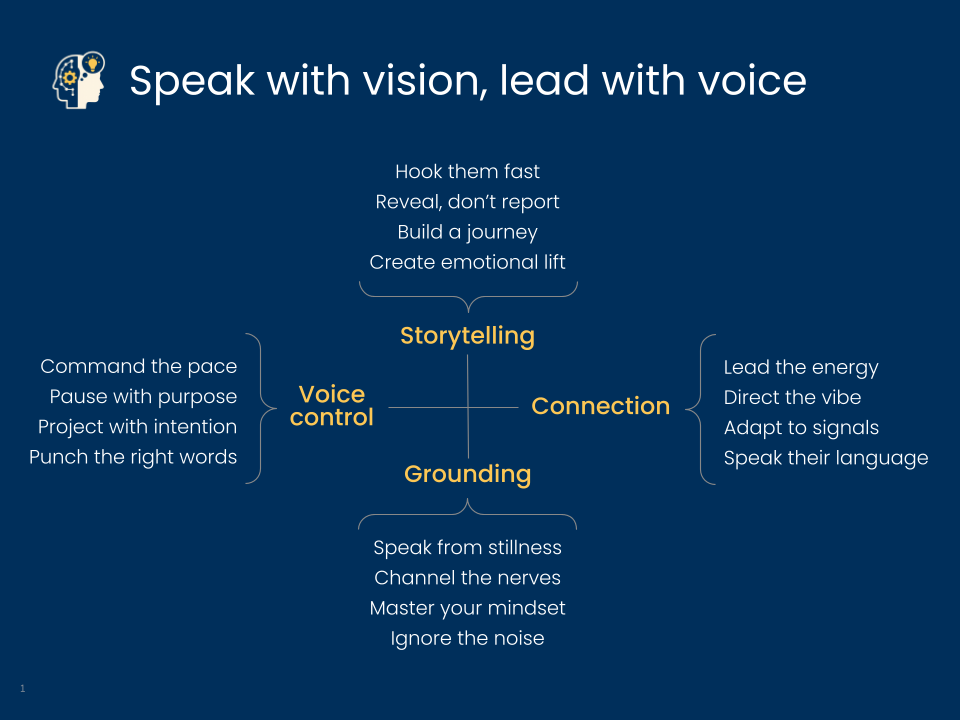
Think of effective speaking as the combination of four essential elements:
1. Storytelling
Stories give your audience a reason to care, to remember, and to act.
Hook them fast – People decide within seconds if they’ll engage or zone out. Start with something that grabs attention: a striking fact, a bold question, or a vivid image.
Reveal, don’t report – Instead of dumping information, unfold it in a way that builds curiosity. Give your audience moments of discovery.
Build a journey – Take your audience somewhere on purpose. Structure your message so each point flows naturally into the next, guiding them step-by-step toward a clear and intentional conclusion. This way, they’re not just listening passively but instead traveling with you, anticipating the next turn, and arriving exactly where you want them to.
Create emotional lift – Facts may inform, but emotion inspires. Create moments that make people feel motivated, hopeful, or empowered to keep them engaged.
2. Voice Control
Your voice is your instrument. How you play it determines whether people lean in or tune out.
Command the pace – Don’t let your nerves or excitement lead the pace. Speak at a rhythm that matches your message. Speed up to energize, slow down to emphasize.
Pause with purpose – A well-timed pause can underline a point more powerfully than any word. Leverage the power of silence.
Project with intention – Speak with clarity, articulation, and presence that communicates confidence and purpose. Your voice should invite respect and engagement, making it clear that your words matter and your audience’s attention is worth holding.
Punch the right words – It’s not about getting louder but instead placing emphasis on the words and phrases that carry the heart of your message. These are the takeaways you want etched in your audience’s memory, the ones that, if remembered above all else, would still deliver your core meaning.
3. Connection
The best communicators treat speech as a shared experience.
Lead the energy – Set and drive the energy that best serves your message. Your energy becomes the emotional cue your audience follows.
Direct the vibe – Keep the room aligned with your message, adjusting if the mood drifts.
Adapt to signals – Read faces, body language, and responses, then adjust your delivery in real time. Respond to boredom with energy. Respond to confusion with more clarity.
Speak their language – Effective communication is not about showcasing one’s vocabulary or grasp of the latest professional buzz words. Use terms, examples, and references your audience understands and values.
4. Grounding
Even the most skilled speaker can falter if they’re overwhelmed. Grounding keeps you steady and present.
Speak from stillness – Your audience will feel your stability. Find your calm center before you begin and intentional return to it if you feel you’ve drifted.
Channel the nerves – Turn nervous energy into purposeful energy. Let it fuel your delivery instead of fighting it.
Master your mindset – Decide before you start that you are prepared, capable, and ready to deliver value and inspire your audience. You are in command of what you choose to think and how you choose to respond.
Ignore the noise – Disregard distractions and the negative voices in your head.
Putting it together
Speaking is never just about transmitting words. It’s about stepping into a moment where you hold the audience’s attention and guide it toward something meaningful. Storytelling draws your audience in, giving them a reason to follow you. Voice control shapes the experience, making each word intentional and alive. Connection transforms the exchange into something personal, where people feel seen, heard, and understood. Grounding keeps you steady when the stakes are high, ensuring that you speak from a place of clarity, not chaos.
When you weave these elements together, you do more than deliver a message — you lead. You command not through force but through presence. You invite people into an experience that feels intentional, from the first word to the last pause.
This is what it means to speak with vision and lead with voice: to be deliberate in how you craft your message, purposeful in how you deliver it, and unshakable in the way you hold the room. Whether you’re addressing a team of five or a crowd of five thousand, your voice can be the bridge between ideas and action. And when you choose to lead with it, you give your audience more than information — you give them a moment they’ll carry forward.