The Journey of Customer Support from Call Centers to AI – Part 2
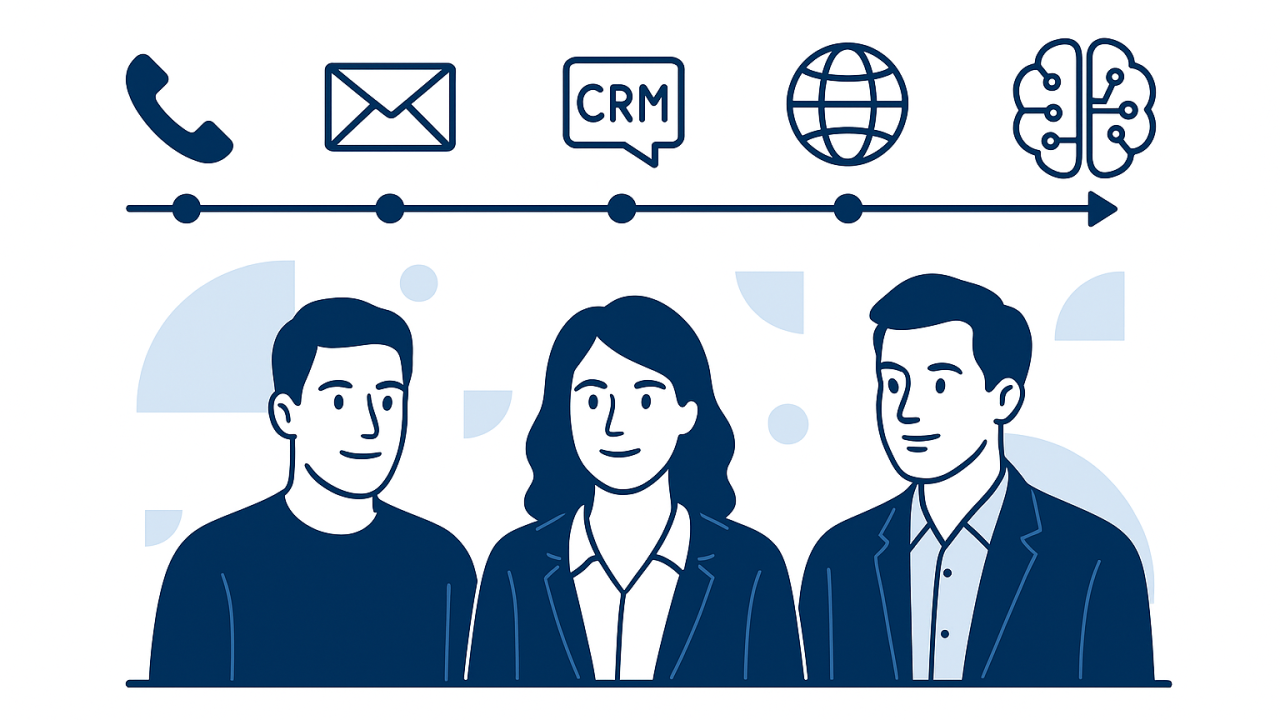
2000s: CRM & The Multi-Channel Revolution
“The future of communicating with customers rests in engaging with them through every possible channel: phone, e‑mail, chat, Web, and social networks. Customers are discussing a company's products and brand in real time. Companies need to join the conversation.” — Marc Benioff, co‑founder & CEO of Salesforce
Internet adoption during the 2000s fundamentally transformed both customer expectations and support capabilities. Email-based support, which had begun informally in the 1990s, evolved into a standardized core channel alongside phone support, and early web-based self-service portals gave customers new ways to find answers independently.
The rise of cloud-based Customer Relationship Management (CRM) platforms such as Salesforce made comprehensive customer data management accessible to businesses of all sizes[1]. These systems enabled integration between previously siloed functions — sales, support, marketing, and operations — while shifting focus from isolated transactions to complete customer relationship tracking and experience management. The proven success of the Software-as-a-Service model triggered an explosion of cloud-based customer support solutions in the marketplace.
With the shift to online came an intense focus on efficiency and performance metrics, and organizations sought to reduce costs through these self-service options and offshore support center expansion, particularly to countries like India and the Philippines. Web-based knowledge bases and online documentation systems became standard, supported by formalized help desk and ticketing systems like Zendesk that enabled structured management of growing email and web-based inquiries[2]. Screen sharing and remote assistance tools also emerged, enabling more effective problem resolution[3]. Live chat and webchat capabilities emerged[4], providing real-time text-based communication between customers and support agents directly through company websites. LivePerson, founded in 1998, created the first live chat platform for businesses, pioneering real-time web-based customer support that fundamentally changed customer expectations for response times.
For the first time, businesses could efficiently measure Customer Lifetime Value (LTV), churn rates, and the direct impact of support interactions on renewal and upsell opportunities. This visibility transformed support organizations from ticket closers into loyalty builders, with retention becoming a shared KPI across marketing, product, sales, and support teams.
These new capabilities and tools also created unexpected challenges. Many organizations lost the personal touch through aggressive outsourcing strategies to reduce costs, often creating language barriers and cultural disconnects, while increasingly complex IVR systems frustrated customers who simply wanted to reach a human agent. Additionally, the proliferation of support channels often created inconsistent experiences as customers moved between phone, email, and web interactions. With the expansion of online support channels, customers were often required to create and remember multiple usernames and passwords for the same company, adding unnecessary friction to the support process. Companies found themselves wrestling with a persistent challenge: maintaining service quality at scale while balancing cost reduction with customer satisfaction.
2010s: The Customer Success Era
Smartphone adoption and social media growth in the late 2000s and early 2010s fundamentally altered the customer support landscape. The iPhone's launch in 2007 and subsequent smartphone adoption drove companies to develop dedicated mobile apps for customer support while pursuing omnichannel strategies to deliver consistent experiences across all customer touchpoints[5]. Support interactions became public and immediate as customers turned to Twitter and Facebook to voice complaints and seek assistance, prompting companies to invest in social media coordinators and response teams. JetBlue Airways exemplified this transformation, pioneering real-time Twitter customer service with 24/7 monitoring and 10-minute average response times. Community-based platforms like Stack Overflow and Reddit became popular self-help forums, providing comprehensive answers without the need to contact official support.
Leveraging new analytics capabilities and integrated customer data, companies made a fundamental shift from reactive to proactive support during this decade. Organizations began reaching out to customers based on usage patterns and predictive analytics, using these interactions to gauge satisfaction and identify opportunities, transforming support from a cost center into a potential revenue driver through upselling and retention activities. With this shift, customer support became a direct funnel to sales.
The integration of support with broader customer success initiatives became a defining characteristic of this era. Customer Effort Score (CES) joined Net Promoter Score (NPS) as key metrics, with many organizations developing composite Customer Health Scores (CHS) to predict customer behavior and identify at-risk relationships. Voice of Customer (VoC) programs became systematic enterprise practices[6] to provide company-wide visibility to metric tracking, progress, and next actions.
2020s: AI-Powered Customer Success
The breakthrough of ChatGPT in late 2022 marked a watershed moment that transformed customer support from automation-focused to intelligence-driven [7]. The novel dazzle and excitement of conversational AI quickly gave way to a grander understanding of how large language models and generative AI can be applied to every aspect of system intelligence. Traditional support systems are giving way to intelligent platforms capable of natural language understanding and continuous learning, moving far beyond processing simple queries and automation to understanding complex, multi-turn conversations. Behind every interaction operates a growing ecosystem of AI models: classifying support inquiries, analyzing sentiment, flagging compliance risks, transcribing full conversations in real-time, and continuously learning from new data. This invisible infrastructure allows support organizations to scale globally while maintaining consistent quality.
AI excels at detecting sentiment and analyzing emotional patterns. Through advanced sentiment analysis, support representatives gain an ever-recalibrating emotional radar that can detect specific emotions like confusion, urgency, or delight within conversations. This granular understanding can power dynamic workflows, allowing systems to automatically adjust response tone, prioritize based on urgency, proactively route disintegrating incidents, escalate to agents with specialized skills, or trigger proactive outreach based on emotional state.
Solution suggestion engines have evolved from simple keyword-matching systems to sophisticated, AI-powered problem solvers. Initially rule-based with limited understanding, they can now seamlessly process thousands of data sources – previous interactions, historical support cases, error logs and system telemetry, customer profiles, documentation, and knowledge bases – to instantly surface relevant answers and tailored responses, all without interrupting conversation flow. These modern engines can support agents with real-time suggestions and enhance customer self-service, blending speed and accuracy with a more human-like understanding. Going beyond the immediate support issue, AI can proactively offer guided tutorials or suggest changes to the customer's product mix, fundamentally shifting beyond reactive to predictive to personalized recommendations for the optimal mix of products, solutions, and services.
While AI has completely exploded the possibilities, the true transformation is how AI has evolved from experimental or helpful tools to the invisible backbone that enhances and extends our human capability. The most significant impact isn't replacement but instead collaboration and enablement. Support professionals are empowered to become more strategic, focusing on customer experience, advocacy, and relationship building while AI handles the emotional analysis and operational complexity. This human-AI partnership creates faster resolution times while maintaining authentic customer relationships, allowing agents to focus on what they do best: delivering meaningful, genuinely human-centered support. And while customers are increasingly comfortable with AI-enhanced support, they still want to know that a human agent is at the wheel, driving the outcomes and focused on customer success. This collaboration represents the full realization of customer experience as a competitive advantage, where technology amplifies human insight to create service that is both scalable and genuinely personal.
Bringing It All Together
And that brings us to present day.
Throughout the decades, from the initial call center in Birmingham to today's AI-powered experience platforms, innovations and disruptors have consistently reshaped how businesses connect with their customers. Each era brought breakthrough technologies and fundamental shifts in thinking that transformed customer support from a necessary cost into a strategic advantage. What began as simple problem-solving has evolved into relationship building, turning frustrated customers into loyal advocates and support agents into strategic partners in business growth. Organizations now view every interaction as an opportunity to strengthen relationships and drive business outcomes.
We've come full circle: customer support started as a human conversation, became a technology-heavy cost center, and evolved to being the most human element of business strategy.
Endnotes
While the concept of CRM originated in the late 1980s and early 1990s with on-premise software, the disruptive shift to cloud-based (SaaS) CRM, pioneered by companies like Salesforce (founded 1999), revolutionized its accessibility and adoption throughout the 2000s.
Early help desk software existed in the 1980s (often for internal IT support), but the 2000s saw the widespread adoption and commercialization of dedicated, web-based ticketing systems designed specifically for external customer service, exemplified by companies like Zendesk (founded 2007).
While remote access technologies had earlier military or technical origins, their commercial deployment and widespread integration into customer support workflows for direct troubleshooting became prevalent in the 2000s.
Solutions like LivePerson were founded in the late 1990s, but webchat did not become standard until the early-to-mid 2000s.
The term "multi-channel" existed earlier than "omnichannel", but the latter gained prominence in the 2010s to describe a more integrated and seamless customer experience across all touchpoints rather than multiple, siloed channels.
While Medallia (founded 2001) and Qualtrics (founded 2002) existed earlier, their enterprise customer experience and VoC platform capabilities gained mainstream adoption during the 2010s.
AI and natural language processing have been developing for decades, but the public release of OpenAI's ChatGPT democratized access to and awareness of advanced conversational AI. This acted as catalyst for widespread industry adoption and a race to embrace and incorporate the technology.